


 Weather
 Entertainment
Blog
Massive 2025 FA22 Asteroid to Fly Past Earth Safely, Confirms NASA

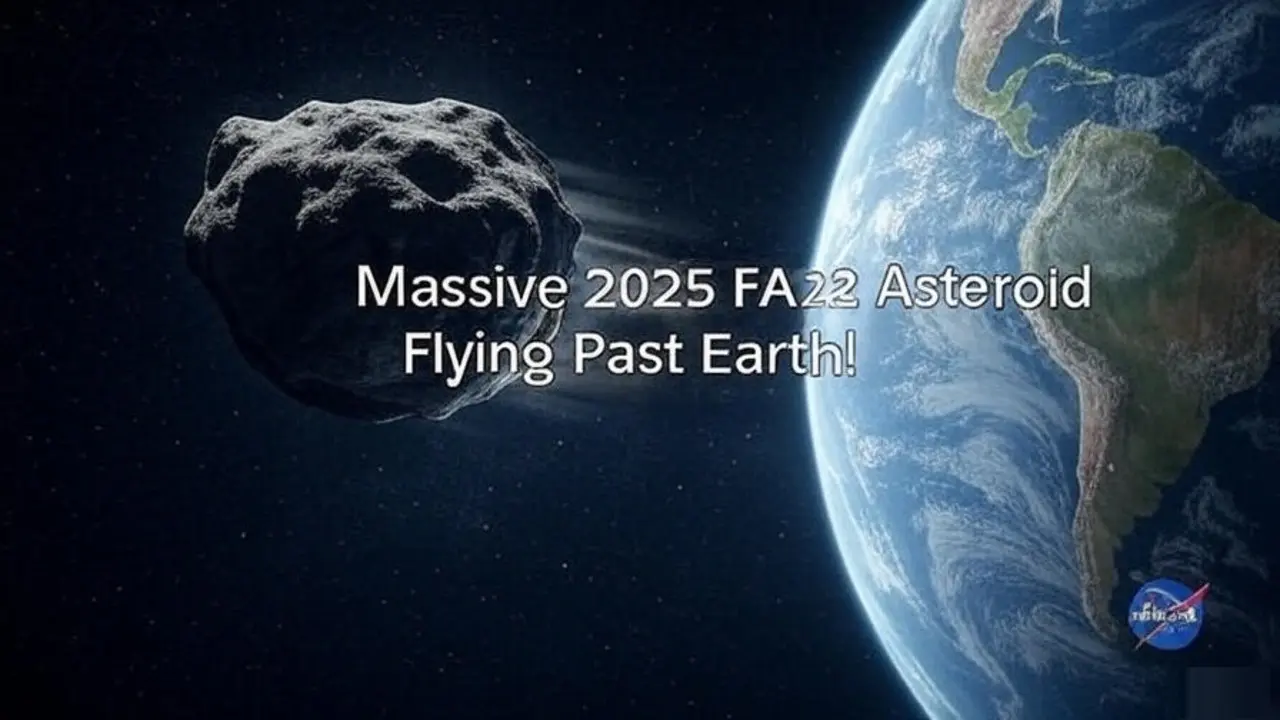
2025 FA22, a massive asteroid, is set to make a close flyby of Earth on September 18, 2025, traveling at a staggering 24,000 miles per hour. According to NASA, this near-Earth object poses no risk of collision, but its size and speed make it a fascinating celestial event for astronomers and skywatchers worldwide.
This asteroid’s close approach provides a unique opportunity for scientists to study its structure, orbit, and behavior, while also reminding humanity of the importance of monitoring space objects.
What is 2025 FA22?
2025 FA22 is classified as a Near-Earth Object (NEO), which means it passes relatively close to our planet. Measuring approximately 390 to 820 feet in diameter, the asteroid is roughly the size of a 70-story building.
Its large size earned it a Potentially Hazardous Asteroid (PHA) designation, although NASA reassures the public that it poses no threat during this flyby. Scientists are closely tracking 2025 FA22 to understand its composition, orbit, and rotational characteristics.
How Close Will 2025 FA22 Come to Earth?
Despite the “close approach” label, 2025 FA22 will safely pass at a distance of about 2.6 million miles from Earth — more than 10 times the distance to the Moon.
Astronomers will take this chance to study the asteroid’s speed, trajectory, and surface features using radar imaging and telescopes. Observing 2025 FA22 improves predictions for future asteroid movements.

The Speed and Power of 2025 FA22
Traveling at 24,000 mph (39,000 km/h), 2025 FA22 is moving faster than any commercial jet by over 40 times. This incredible speed, combined with its size, makes the asteroid an ideal subject for scientific observation.
NASA experts will analyze how 2025 FA22 reflects sunlight, its rotation, and surface composition. Such data helps refine models of asteroid behavior and ensures Earth’s safety in the long term.
Why NASA Is Monitoring 2025 FA22
Even though 2025 FA22 poses no immediate danger, NASA’s Planetary Defense Coordination Office (PDCO) constantly monitors asteroids to detect any potential threats early.
Tracking 2025 FA22 allows scientists to improve orbital predictions and prepare mitigation strategies if a hazardous asteroid is ever discovered in the future.
Past Asteroid Events Highlight the Need for Monitoring
In 2013, a smaller asteroid exploded over Chelyabinsk, Russia, causing over 1,000 injuries despite being only 65 feet wide.
Events like this show why monitoring large near-Earth objects, including 2025 FA22, is essential. It ensures scientists have data to prevent or mitigate potential damage from future cosmic encounters.
Visibility of 2025 FA22 from Earth
2025 FA22 will not be visible to the naked eye due to its distance and speed. However, astronomers with high-powered telescopes will be able to spot it as a faint moving dot in the night sky.
Observatories around the world are preparing to share live images and videos of this flyby, making it accessible to space enthusiasts and the general public.
Scientific Importance of 2025 FA22
Asteroids like 2025 FA22 are ancient remnants from the early solar system. Studying their composition, rotation, and orbital behavior helps scientists understand how planets, including Earth, were formed billions of years ago.
The flyby of 2025 FA22 also provides valuable data for planetary defense strategies, like NASA’s DART mission, which successfully redirected a small asteroid in 2022. These insights prepare humanity for possible future threats.
Quick Facts About 2025 FA22
- Name: 2025 FA22
- Classification: Near-Earth Object (NEO) / Potentially Hazardous Asteroid
- Speed: 24,000 mph
- Size: 390–820 feet
- Closest Approach: September 18, 2025
- Distance from Earth: 2.6 million miles
- Threat Level: None
A Safe But Spectacular Flyby
The flyby of 2025 FA22 is a safe yet awe-inspiring cosmic event. Scientists will gather valuable data to refine asteroid tracking and planetary defense strategies, while the public gets a rare glimpse of the power and dynamism of our solar system.
2025 FA22 reminds us of Earth’s vulnerability, the wonders of space, and the importance of scientific vigilance to ensure our safety from potential cosmic hazards.
-
 Trending
- Daily Horoscope Today: Zodiac Predictions for All Signs
- Stock Market Christmas 2025 Holiday: NSE BSE Closed

- 7 Daily Habits That Can Help You Live Beyond 90

- Astrospeak Today Horoscope: 12 Powerful Zodiac Predictions
- Vikrant Massey Best Actor Award – 5 Stunning Highlights from the 71st National Film Awards

- 5 Shocking Facts About Suryakumar Yadav’s ICC Fine Explained

- Mumbai Rain Alert: IMD Issues Orange Warning